A smarter way to decide what AI to build.

The Starkey Model™ scores every use case against value your board defines, weighted by the people closest to the work, with a written rationale for every decision.

For the transformation lead or strategy director who has to put a defensible AI portfolio in front of the board. From Chapter 6 of The Intelligence Organization, Megan Starkey’s forthcoming book, run live on forty use cases at a Fortune 1000 insurer.

Assembled on order. By email within three business days.
Four decision states, two pre-committed thresholds
Business Value · threshold 2.5
Develop NextHigh value, constrained today. Roadmap the barriers away.
Drive NowHigh value, realistic path. Fund with dedicated resources.
DeferNeither the value nor the path. Rethink or shelve.
Do GraduallyEasy but modest. Take it as resources permit.
Feasibility · threshold 3.0

The expensive part of AI is choosing wrong.

42%
of companies abandoned most of their AI initiatives in 2025, up from 17% the year before.
S&P Global Market Intelligence
$2.3M
what one equal-weight scoring decision cost a Fortune 1000 financial services company.
Chapter 6, told in full
40
use cases scored in one live session at a Fortune 1000 insurer, using this model.
Chapter 6

These are prioritization failures. The Starkey Model is the discipline applied before a dollar moves.

The method behind the kit, chapter and verse.

The Starkey Model is Chapter 6 of The Intelligence Organization, the forthcoming book by Megan Starkey, CEO and Principal Consultant of RBD. The method is not hidden behind the checkout: the full chapter ships with the Organization and Enterprise tiers, ahead of the book.

The four decision states, from Chapter 6 of The Intelligence Organization by Megan Starkey
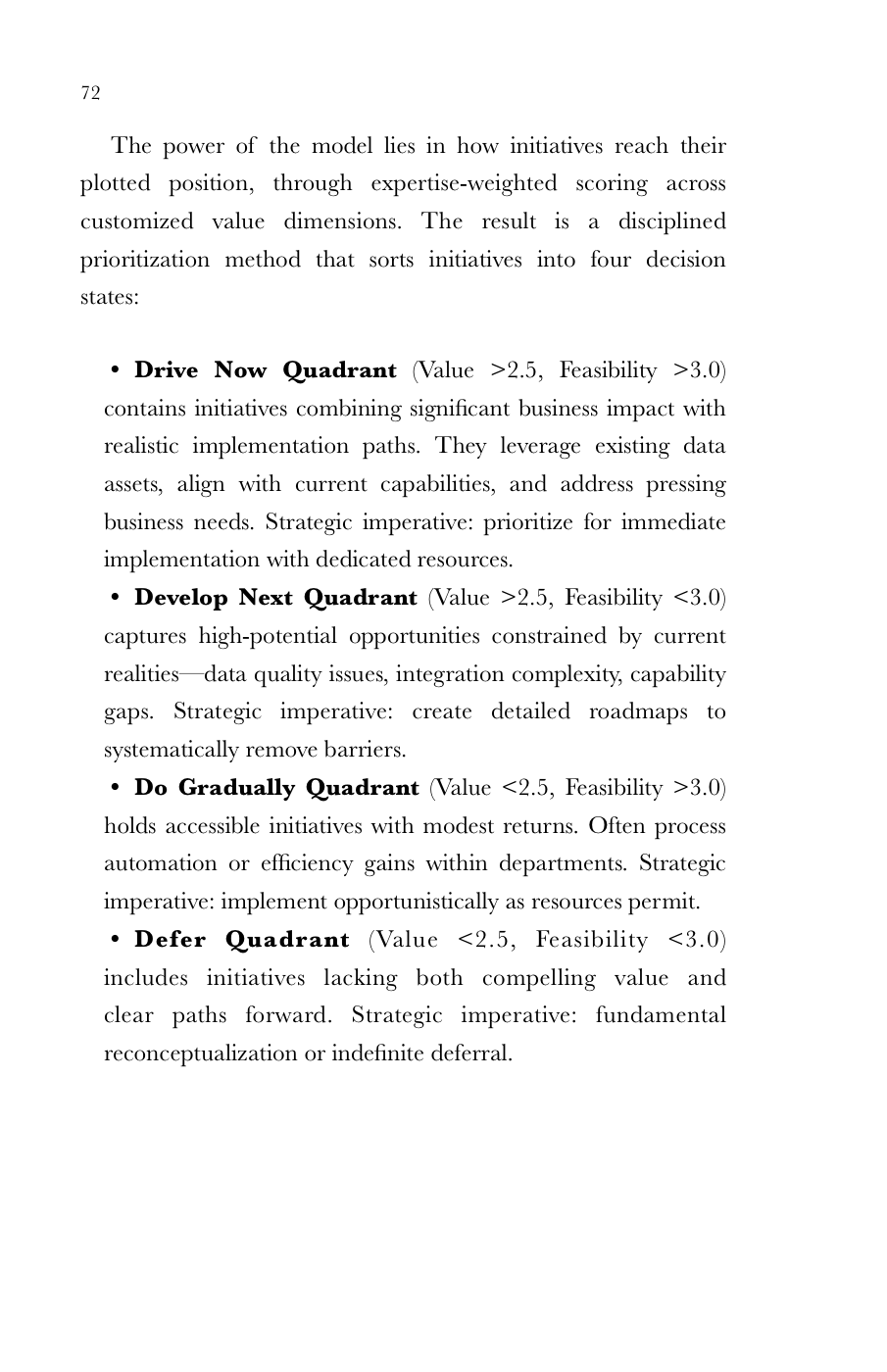
Chapter 6, as it appears in the book: the four decision states.

Value and feasibility are where most frameworks stop. This is where the model starts.

Every 2×2 plots value against feasibility. The Starkey Model governs what those words mean and who gets to say.

Value is defined before anyone scores

Every seat agrees customer experience matters. One measures deflected tickets; another measures sentiment. The model forces the definition and the weight first, on the value dimensions your board names as strategic priorities, so success six months later has one meaning.

The people closest to the work do the scoring

Scoring weight follows domain expertise, not org-chart position. Equal-weight democracy felt fair at that Fortune 1000 panel, and it funded a $2.3M dashboard the sales team never wanted.

Every decision carries its rationale

Judgment becomes data that can be examined, debated, and trusted. You can show the board why Initiative A was funded and Initiative B was not, and defend it a year later.

Value dimensions, one engagement's weightingFrom Chapter 6
Revenue Impact25%
CX Enhancement20%
Innovation Lift20%
Risk Reduction15%
Output Quality10%
Process Speed10%

Most frameworks rank projects. The Starkey Model allocates capital.

Every initiative lands in one of four decision states.

The thresholds are set before anything is measured against them, and held constant through the evaluation. That pre-commitment is the discipline.

Drive NowValue >2.5 · Feasibility >3.0
Significant impact with a realistic path. Fund it now, with dedicated resources.
Develop NextValue >2.5 · Feasibility <3.0
High potential blocked by data quality, integration, or capability gaps. Roadmap the barriers away, then fund it.
Do GraduallyValue <2.5 · Feasibility >3.0
Easy wins with modest returns. Take them as resources permit; never let them crowd out Drive Now.
DeferValue <2.5 · Feasibility <3.0
Neither compelling value nor a clear path. Rethink it from scratch or shelve it, on the record.

Five steps, start to defensible portfolio.

The kit walks each step; the templates carry the work.

1 · Set the thresholdsbefore anything is scored
Value 2.5, feasibility 3.0, committed up front and held constant through the evaluation. The bar is set before any initiative is measured against it.
2 · Define value dimensionsyour board’s priorities, weighted
Your leadership names what value means, dimension by dimension, and weights each one. Success six months later has one definition.
3 · Assemble the panelfive to seven seats
The people closest to each initiative, with influence weighted by domain expertise rather than org-chart position.
4 · Build the library and scoreevery initiative, every dimension
Each initiative in your portfolio gets scored on each dimension by the weighted panel, in one working session or quarterly cycles.
5 · Read the gridfour decision states, rationale on record
Every initiative lands in Drive Now, Develop Next, Do Gradually, or Defer, with the written reasoning your board can examine.
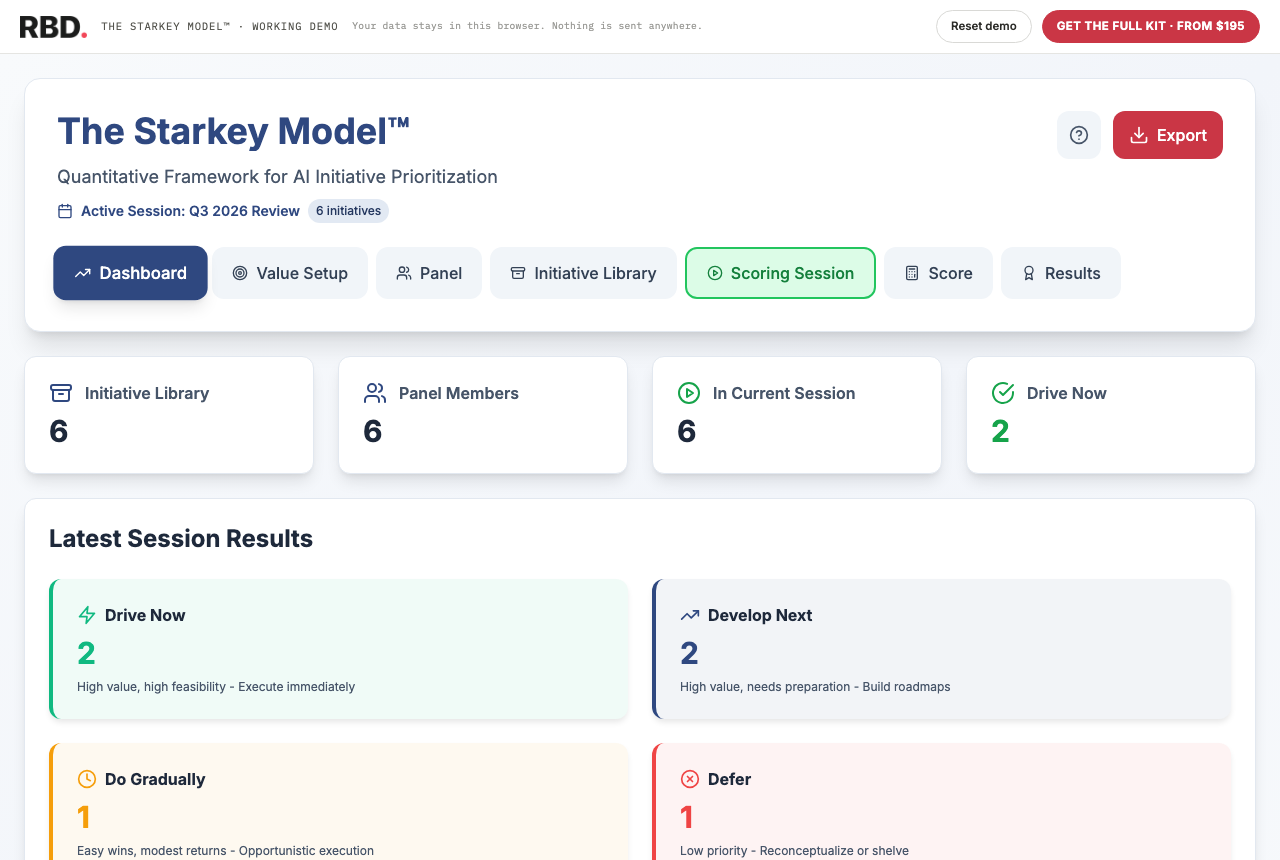
The Starkey Model app dashboard with seven working screens
The working app: value setup, panel, library, scoring, and results as seven screens. Drive Now is the list your board funds.
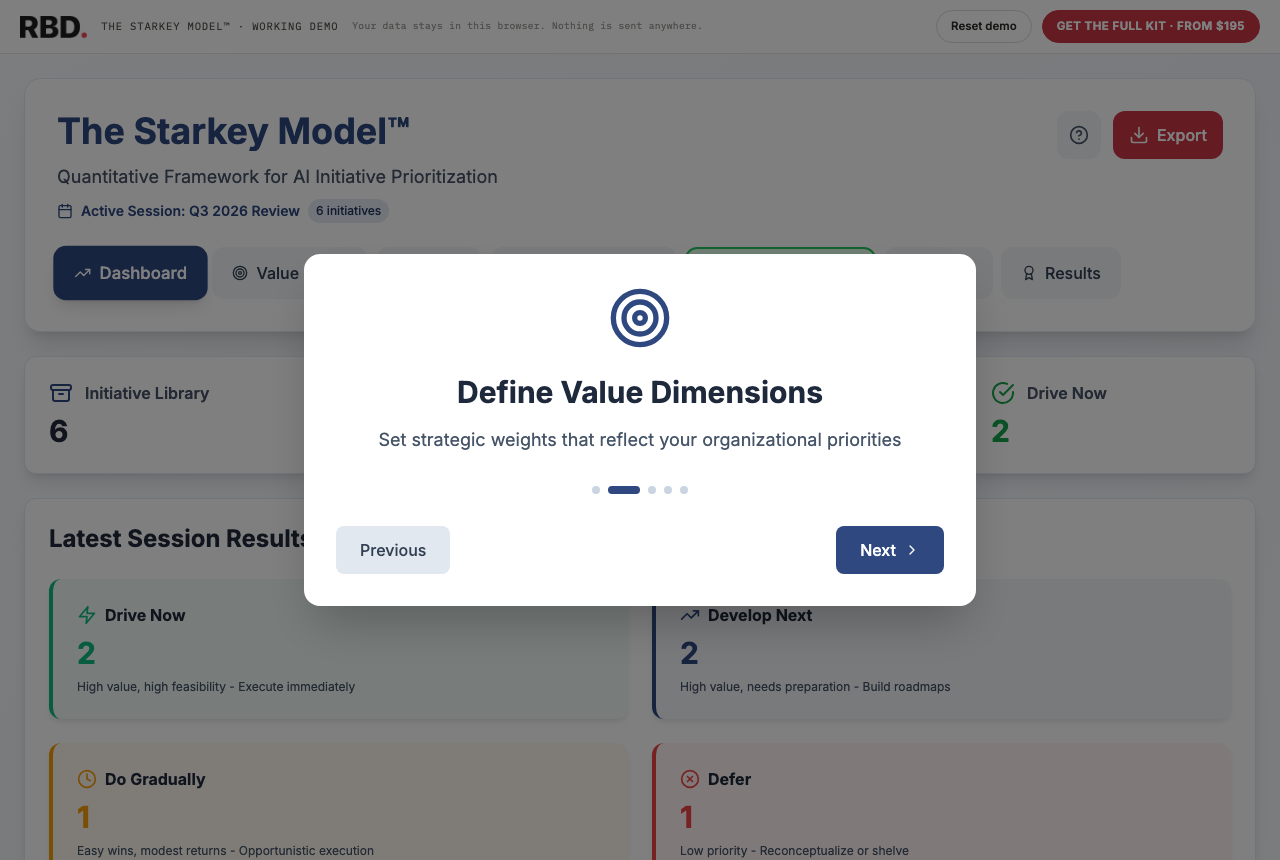
Define Value Dimensions step in the Starkey Model app
The app walks the five steps in order, starting with what value means to your board.
See how it works · try the demo Runs in your browser. Your data stays on your machine.

One use case, scored end to end.

A worked example in the kit’s own scoring instrument. Yours run on your board’s dimensions, your weights, your panel.

Contract-renewal risk alerts · scoring recordWorked example
Revenue Impact · 25%4.0
CX Enhancement · 20%3.5
Innovation Lift · 20%2.5
Risk Reduction · 15%4.0
Output Quality · 10%3.0
Process Speed · 10%3.0
Weighted value 3.5 · Feasibility 3.6Drive Now
Rationale on record: renewal owners scored it, not the loudest room; the sales operations lead carried the largest panel weight, finance kept the revenue math honest. Funded over two louder ideas.

What arrives.

A kit assembled for your purchase, by email within three business days.

From $195. Three tiers.

A $50,000 to $250,000 consulting engagement buys two things: the framework design, and months of consultant labor to run it. The framework here is already built, written up in full in Chapter 6 of her forthcoming book, and proven live on forty use cases. The kit delivers it ready to calibrate to your organization; your team supplies the labor, guided by the templates and the calibration protocol. That is what $195 to $895 buys, and why it is not $50,000.

Included Individual$195 Organization$495 Enterprise$895
Complete scoring methodology + criteria framework
The scoring app (single HTML file, data persists in your browser)
6 implementation templates
Evaluator calibration protocol
Chapter 6: The Intelligence Organization
Single-user license
Organizational license (unlimited internal use)
60-minute calibration call with Megan Starkey, the model’s author
Organization-specific model calibration
Post-deployment scoring review (up to 40 initiatives; written notes plus a call)
Follow-up calibration call with Megan Starkey
Individual
$195

Complete framework and templates. Single-user license. For independents and researchers.

Purchase
One-year license · Single user
Organization · Recommended
$495

Everything in Individual plus the organizational license. Recommended for any team deploying together: one license covers unlimited internal use across your organization.

Purchase
One-year license · Unlimited internal use
Enterprise
$895

Everything in Organization plus the 60-minute calibration call with Megan Starkey, the model's author, a post-deployment review of your first scored portfolio, and follow-up calibration. For first runs of 25 or more use cases.

Purchase
One-year license · Unlimited internal use · Includes two calls

Multi-division deployments. For global or multi-division rollouts requiring custom scoping, pricing is calibrated to organizational complexity.

Inquire

What happens after you pay. Checkout confirms and your receipt arrives by email. The kit is assembled for your tier, the scoring templates configured to it, and delivered by email within three business days. On the Enterprise tier, the scheduling link for your calibration calls with Megan Starkey arrives with the kit.

Why there is no refund. Digital delivery; all sales are final, per the Terms of Sale and Refund Policy. In place of a guarantee, the method is not hidden behind the checkout: the worked example above shows the scoring instrument itself, and this page lists every item in each tier before you pay. If anything is missing or broken on arrival, email ops@rbdco.ai and it gets fixed the same business day.

One-year license covering internal use of the model and templates. Everything you produce with it, scores, portfolios, and board documents, is yours to keep permanently. The Terms of Sale and Refund Policy govern your purchase.

Before you buy.

How is this different from a standard 2×2 priority matrix?
Standard matrices use fixed criteria and equal weighting. The Starkey Model weights evaluators by domain expertise and scores against value dimensions your board defines. The result is a portfolio concentrated on the initiatives most likely to return, with a documented rationale for every decision.
Does this work in my industry?
The model is industry-agnostic by design: you measure the dimensions that matter for what you are evaluating. The Enterprise tier includes a calibration call with Megan Starkey specifically to fit criteria and weighting to your operating environment.
What do I actually receive?
The complete methodology by email: the criteria framework with definitions and weighting guidance, six implementation templates, the evaluator calibration protocol, and the scoring app as a single HTML file with your data persisting in your browser and JSON export. The app is a working tool, not production software; the templates run in spreadsheets too, which is how client engagements run it. Organization adds unlimited internal use and the complete Chapter 6; Enterprise adds calibration calls with Megan Starkey.
We already have a prioritization framework. What does this add?
Most internal frameworks select projects well. This adds what most miss: the right people scoring each initiative, input weighted by expertise, and capital concentrated against your board's own definition of value. If your framework already shows why Initiative A was funded over Initiative B, you may not need it.
What does the one-year license cover, and what happens after?
The license covers one year of internal use of the model and templates. Everything you produce with it, scores, portfolios, and board documents, is yours to keep permanently; your work never expires.
Can we deploy without the implementation call?
Yes. Individual and Organization are self-serve: the complete methodology, all templates, and the calibration worksheet to run the fitting yourselves. The calibration calls with Megan Starkey are an Enterprise feature.
Put a defensible AI portfolio in front of your board.

Fund what returns, sequence the rest. From $195, delivered by email within three business days.

Get the Model