Reference guide, twelve archetypes, ten-skill matrix, six input specs, and a working Google Sheet
Why this exists
AI hiring is failing upstream of the labor market.
A board approves an AI plan, delegates execution to the CIO, CAIO, or CHRO, and opens requisitions against a generic role taxonomy, in that order, across mid-market and enterprise organizations almost every time. Time-to-fill stretches past forty-four days, candidate abandonment runs above sixty percent, and most hires that land do not stay eighteen months. Leaders treat the problem as a labor-market issue or a JD problem, but role design causes the failure: it is an output of work specification, not an input to it.
The status quo
Requisitions open before the work is scoped, and the organization waits for the market to produce a fit.
A board approves an AI strategy; scope is left implicit.
A search firm writes the JD from a generic role taxonomy.
The interview panel asks technical questions against an undefined mandate.
Candidates abandon at roughly sixty percent before decision.
The seat fills at forty-four days, and the hire often leaves inside eighteen months.
Six months later, the board asks why there is still no AI program in motion.
With AI Role Design
The work is specified first, and the role is designed as an output of that specification.
Six organizational inputs are scored before any requisition opens.
Twelve archetypes are ranked against your actual signals rather than the market's defaults.
The hiring sequence auto-populates Q1 through Q4 against organizational maturity.
Each JD is written to the archetype's operating context rather than a generic template.
Candidates interview against a defined mandate, and the retention curve shifts accordingly.
The board sees a plan, not a first hire.
47%
Longer to fill a senior AI role than a standard tech role, 44 days against 30 (LinkedIn Talent Insights, Q1 2026)
60%
Candidate abandonment before decision on AI role searches
84%
Of organizations have not redesigned work processes for AI (McKinsey, 2025)
89%
Still run on industrial-age operating models the labor market no longer fits
The model
Twelve archetypes across four clusters, organized by one decision framework.
The AI function is structured around a small set of archetypes that serve four distinct organizational purposes. Each archetype carries its own compensation band, reporting line, skill signature, and sequencing logic, and together they constitute the twelve-role taxonomy published inside the toolkit. The preview below shows the shape of the taxonomy; in the reference guide, every role is named, positioned, and specified in full.
Exhibit 01 . The taxonomy (preview)
Twelve archetypes organized across four functional clusters
Source: RBD. AI Role Design framework, Q2 2026. The toolkit publishes every archetype name, comp band, reporting line, and skill signature.
Strategic
Governs direction and authority.
Carries portfolio accountability, sits board-visible, and sets the operating model around AI. Typically reports to the CEO.
3 archetypes · $220K to $900K+ TC
Bridge
Translates strategy into execution.
Connects business problems to AI solutions. This cluster is the one most frequently cut to save cost and the one most frequently implicated in the post-mortem of a failed program.
3 archetypes · $180K to $320K TC
Technical
Builds and operates the systems.
Covers production models, platform, data products, and novel research. The labor market can fill most of these roles, though demand remains competitive.
4 archetypes · $170K to $380K TC
Operational
Drives adoption and daily use.
Covers workforce fluency, prompt systems, and AI operations. The labor market here is emergent, and organizations that sequence these roles early tend to outperform on adoption.
2 archetypes · $130K to $200K TC
The operating instruments beneath the taxonomy.
Three previews follow, each partially redacted for this public page. Inside the toolkit, all three appear in full and in context.
Preview . Ten-skill matrix
Every archetype against ten skills at three proficiency depths
Archetype
Strat
ML
MLOps
Data
Gov
Prod
Chief AI Officer
E
F
F
P
E
P
Head of AI Strategy
AI Product Manager
ML Engineer
+ 8 more archetypes
E = EXPERT . P = PROFICIENT . F = FOUNDATIONAL
Preview . Archetype card (1 of 12)
Archetype 01
Chief AI Officer (CAIO)
Owns enterprise AI strategy, portfolio, and P&L. Chairs the AI governance body. Reports AI-driven financial results to the board. Not a technical role. A strategic executive who understands AI materially enough to allocate capital against it.
Seniority
C-suite, EVP
Reports to
CEO
Comp band
$450K to $900K TC
Key signal
P&L authority
Eleven more cards inside. Comp bands and skill signatures unredacted in the toolkit.
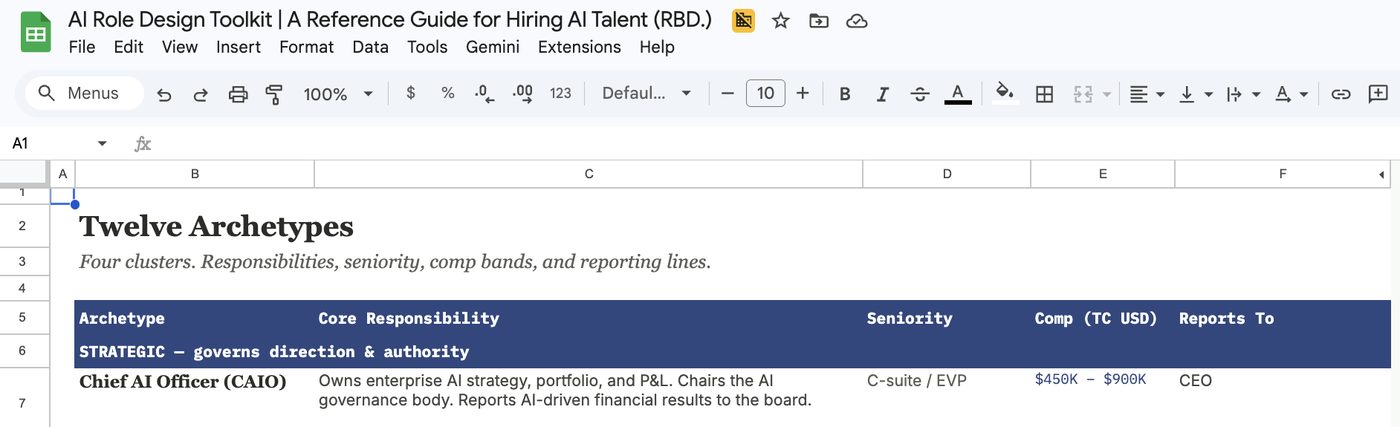
Exhibit 02 . The archetype library, from the working Sheet
The Sheet as delivered. One archetype row of twelve shown; the toolkit is unredacted.
Six organizational inputs, scored before any requisition opens.
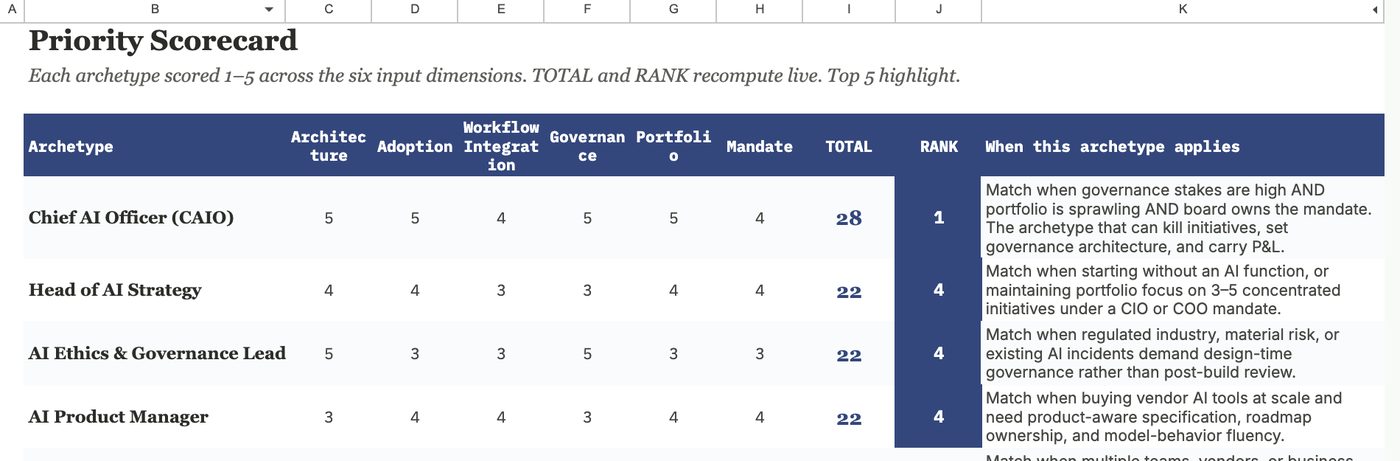
Because role design is downstream of work specification, six organizational dimensions must be scored before any archetype is ranked. The toolkit scores each dimension on a five-point scale, feeds the results into a priority scorecard, and produces a hiring sequence that reflects your actual organizational signals rather than the market's defaults.
Exhibit 03 . The Priority Scorecard, from the working Sheet
The Sheet as delivered, four rows of twelve shown. TOTAL and RANK recompute as the six inputs change.
Input 01
Enterprise Architecture Posture
Input 02
Adoption Readiness & Fluency
Input 03
Workflow Identification
Input 04
Governance Architecture
Input 05
Portfolio & Capital Evaluation
Input 06
Strategic Mandate
Each input's definition, scoring rubric, and consequence chain lives in Chapter 2 of the reference guide.
In application
A single framework producing three different sequences.
The three composites below, drawn from recurring patterns across RBD. client engagements in insurance, financial services, manufacturing, and professional services, illustrate the same toolkit producing three distinct hiring plans. The six input specifications score differently in each organization, so the resulting sequence differs too, by design.
Composite One
Mid-market manufacturer, $600M revenue
A fragmented legacy stack, low AI fluency across the workforce, no named AI owner, and a board-level mandate without an operating framework in place.
Resulting sequence
1. Head of AI Strategy
2. AI Enablement Lead
3. MLOps / Platform Engineer
Composite Two
Regulated financial services, $12B AUM
A strong governance posture and moderate workforce fluency, offset by fifteen AI pilots in flight with no consolidated P&L ownership and visible portfolio sprawl.
Resulting sequence
1. Chief AI Officer
2. AI Ethics & Governance Lead
3. AI Program Delivery Manager
Composite Three
Enterprise SaaS, scaled engineering org
A unified data platform, high workforce fluency, a CAIO already seated, and twelve experiments in flight without a clear path to production.
Resulting sequence
1. AI Product Manager
2. MLOps / AI Platform Engineer
3. Data Product Owner
Composite organizations, not specific clients. Patterns consolidated from multiple RBD. engagements.
What's included
Two instruments that carry one framework.
The toolkit is delivered as two instruments designed to be used together. The reference guide specifies the framework and publishes the full archetype taxonomy. The working Google Sheet turns your organization's inputs into a live priority scorecard and a quarter-by-quarter hiring sequence, both of which recompute as you adjust the signals.
Instrument One
Reference Guide
Chapter 03
The Twelve Archetypes
Chapter 04
The Decision Tools
Chapter 01
Why AI hiring fails before the interview
A five-chapter publication in the RBD. format containing the full framework, every archetype, every input specification, every decision tool, and three applied cases at three organizational scales.
Chapter 1. Why AI hiring fails before the interview
Chapter 2. Six input specifications, each with rubric and consequence
Chapter 4. Decision tree . hiring sequence . JD template
Chapter 5. Three applied cases with full sequence rationale
Sources & methodology. Every figure cited to a named, dated source, with the methodology and its caveats stated
Instrument Two
Working Google Sheet
AI Role Design . Working Toolkit
Cover
Input Specs
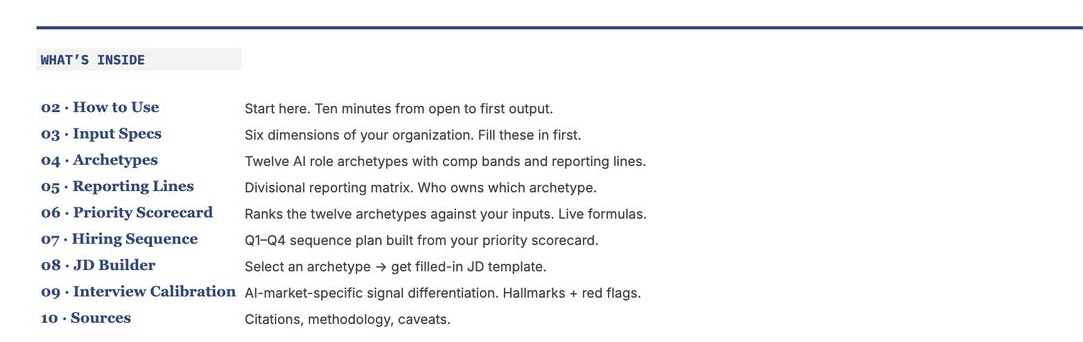
The Sheet as delivered . ten tabs of formula-driven scoring
Copy the master Sheet into your Drive in a single click, fill the six dropdowns on the Input Specs tab, and watch the priority scorecard recompute live as the hiring sequence builds itself against your organizational signals.
Input Specs. Six dropdowns. Your organization's scoring lives here.
Priority Scorecard. Every archetype scored 1 to 5 across six dimensions. Live formulas.
Hiring Sequence. Top four archetypes pulled into Q1 through Q4 automatically.
JD Builder. Pick an archetype. Get the structural JD in RBD. format.
Reporting Lines. Divisional matrix showing who owns which archetype.
Interview Calibration. Per-archetype hallmarks and red flags, calibrated to the AI hiring market, for the panel to use before the first interview.
Plus four more tabs. Cover, how to use, the twelve-archetype detail with comp bands, and sources.
Access tiers
One toolkit, one access key.
The Toolkit delivers the working instrument. The Workforce 2030 research brief supplies the strategic context around it, open reading in the research library. Your key opens the Toolkit immediately after purchase.
For context. An executive search for a Chief AI Officer typically runs $50K to $150K in retainer fees and ninety-plus days of calendar time, and a misfire at day forty-four costs measurably more than both. The toolkit sits upstream of that process, specifying the work before requisitions open, for $195 once.
The Toolkit
AI Role Design Toolkit
$195 one-time
Reference guide. Five chapters covering the full framework, twelve archetypes unredacted, six input specs with scoring rubrics, the ten-skill matrix, the decision tree, the hiring sequence, the JD template, and three applied cases.
Working Google Sheet. Ten tabs of formula-driven scoring, a live priority ranking, and the JD Builder.
Immediate access. Your access link opens the reference guide and the Sheet right after purchase, and arrives again in your confirmation email.
The toolkit answers which roles. The research answers why now.
Four forces are reshaping enterprise talent strategy simultaneously, and each one compounds the others. The toolkit provides the operational response. The companion research brief, Workforce 2030: Four Forces Reshaping Enterprise Talent Strategy, provides the strategic narrative for the pressure the four forces together generate, and it is open reading in the research library.
Organizational decentralization. Why traditional org charts no longer absorb AI capability.
Hiring market dysfunction. Why CAIOs with real P&L history are a pool of dozens globally.
Gig economy structural shift. Why fluency programs outrank full-time hires for some archetypes.
AI acceleration. Why the design window closes in twenty-four months across all four forces.
Questions
The questions we hear before purchase.
Is this a framework, or a product I can actually apply?
Both. The reference guide specifies the framework, and the companion Google Sheet operationalizes it: you fill six dropdowns on the Input Specs tab, the Priority Scorecard ranks archetypes against your organizational signals, and the Hiring Sequence pulls the top four into a Q1 through Q4 plan automatically. A senior leader can produce a defensible hiring plan in a single sitting.
How is this different from a generic JD template library or an AI-roles list?
Generic taxonomies list archetypes; this toolkit sequences them. The ten-skill matrix surfaces which roles are too narrow or too broad for your context, and the six input specifications determine which archetype comes first for your organization rather than for the market as a whole. The decision tree also catches the single most common hiring error we see in post-mortems of failed AI programs: the Bridge cluster is routinely skipped, and the diagnosis almost always points back to that omission. No JD library contains that pattern, because the pattern is organizational rather than role-level.
We are in a regulated industry. Does this apply?
Yes, and the framework sequences regulated organizations differently by design. Under the EU AI Act and comparable U.S. regimes, the AI Ethics and Governance Lead functions as a named regulatory contact rather than a ceremonial reviewer. Composite Two in the applied cases is modeled on a $12B-AUM financial services firm where the resulting sequence hires governance before delivery. The Workforce 2030 brief in the research library covers the broader compliance dimension.
We already have a CAIO in place. Is there still value here?
Yes. Composite Three in the applied cases is modeled on an enterprise SaaS organization with a CAIO already seated, and the sequence that follows identifies Product Manager, MLOps, and Data Product Owner as the next three hires. The toolkit functions as the decision framework for the second, third, and fourth hire rather than the first. The ten-skill matrix also serves a secondary diagnostic purpose, because it surfaces whether the CAIO in seat is operating as a CAIO or as a relabeled CIO, which is a question worth running explicitly.
What exactly does $195 buy?
The complete toolkit: the five-chapter reference guide with all twelve archetypes, the six input specifications with scoring rubrics, the ten-skill matrix, the decision tree, the hiring sequence, the JD template, the three applied cases, and the ten-tab working Google Sheet that operationalizes all of it. Your access opens immediately after purchase. The Workforce 2030 research brief that supplies the strategic backdrop is open reading in the research library.
Design the roles before you open the requisitions.
Built to be used inside a single leadership conversation. Bring it to the next board meeting, the next search firm briefing, or an executive team session where AI hiring is on the agenda.