The Starkey Model™

The Starkey Model puts the people closest to each initiative at the center of evaluation, scores against the value dimensions your board defines as strategic priorities, and concentrates your portfolio on the investments most likely to return results — with a documented rationale for every decision.

The difference is in who’s at the table, what you measure, and where the capital goes.

Traditional Priority Matrix

Standard process: uniform scoring, equal weighting, consensus output.

  • All participants score every initiative, regardless of domain expertise
  • Evaluator input carries equal weight across all dimensions
  • Selection rationale typically undocumented or reconstructed after the fact
  • Output shaped by committee consensus
  • Project-by-project selection — no portfolio-level view of capital concentration
The Starkey Model

Right people, right criteria, highest-return portfolio.

  • Evaluation panels assembled by demonstrated domain expertise — not org chart position
  • Stakeholder input weighted by proximity to the work being evaluated
  • Every decision documented with full scoring rationale, version history, and evaluation trail
  • Portfolio governance — the full investment landscape evaluated simultaneously, not project-by-project
  • Output your board can stand behind — documented rationale that holds through leadership transitions and audits

Two dimensions, custom criteria, expertise-weighted.

The Starkey Model evaluates every AI initiative across two dimensions: Organizational Value Potential and Implementation Feasibility. The difference: it gets the right people to the table for each dimension. A data architect’s feasibility assessment carries more weight than a business sponsor’s. A market strategist’s value score outweighs an engineer’s. The people closest to the work drive the scoring.

The output: a portfolio view where capital concentrates on your highest-conviction initiatives — with documented rationale, full scoring trail, and a board-ready investment narrative.

The logic: When you measure the criteria that matter most to your board’s strategic priorities, scored by the people closest to the work, capital concentrates on the initiatives most likely to deliver — fewer bets, higher conviction, faster time-to-value.

Axis 1
Organizational Value Potential
Composite of strategic alignment, measurable business impact, and capability multiplier effect. Weighted by organizational priority context.
Axis 2
Implementation Feasibility
Composite of technical maturity, organizational absorption capacity, and time-to-value. Calibrated against the implementation dataset.
High Value Potential
Strategic Initiative
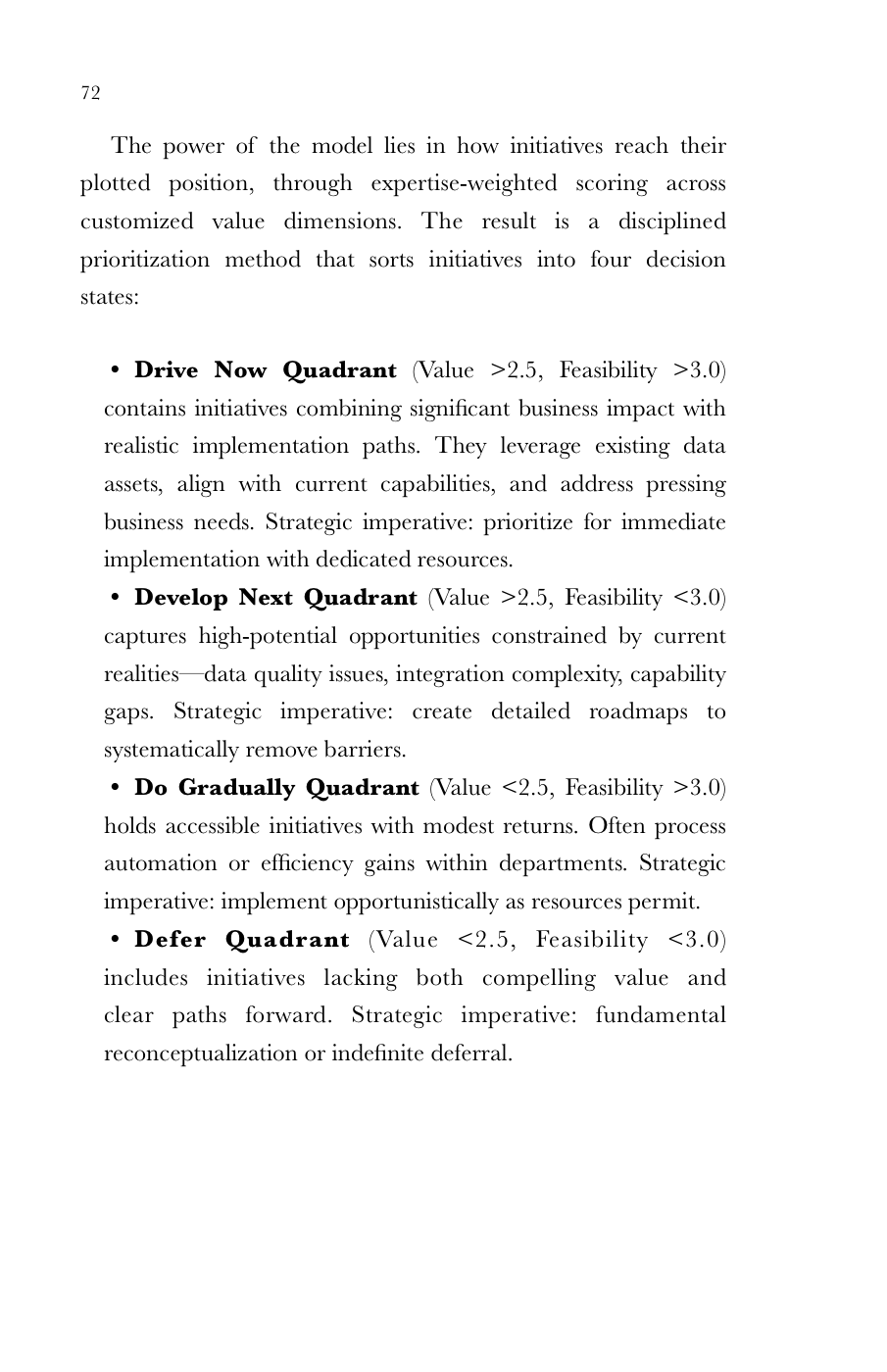
Develop Next
Strategic Priority
Do Now
Defer
Incremental Gain
Do Gradually
Lower Feasibility Higher Feasibility
Lower Value Potential
Priority Matrix
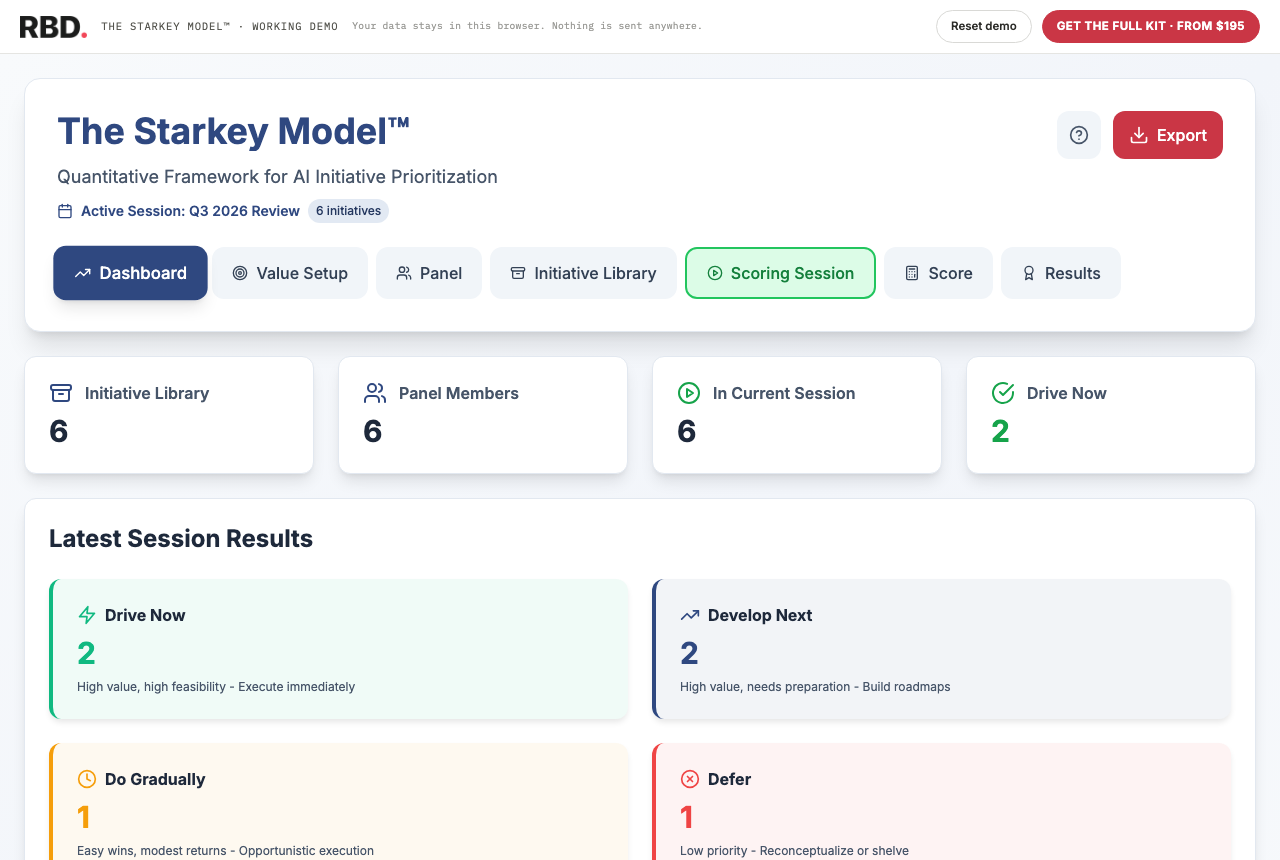
Every use case lands in one of four positions. Priority position drives resource allocation, sequencing, and success metrics — with full documentation of why.

What governed prioritization produces.

Client Application

A $4B property & casualty insurer deployed the Starkey Model in its flagship commercial lines division — the business unit selected to prove governed AI portfolio management before enterprise-wide adoption. The framework replaced a steering committee model that had approved 23 concurrent initiatives with no documented selection criteria. After implementing governed scoring, the portfolio was reduced to 7 high-conviction initiatives with full evaluation rationale — and the first cycle produced a board-ready investment narrative in under two weeks.

2.5×
ROI differential between governed portfolios (fewer, higher-conviction bets) and distributed selection models
3–5
Initiatives targeted by top-performing portfolios, versus 15–30+ in undisciplined selection models

All figures independently verified · Engagement-specific case studies available under NDA

Everything you need to deploy governed prioritization.

Custom Evaluation Criteria Framework
The methodology for defining criteria that match your priorities and context — not a fixed checklist. You measure what matters for what you’re evaluating, calibrated across both axes.
6 Implementation Templates
Panel assembly worksheets, scoring instruments, portfolio visualization templates, decision documentation formats, and board narrative scaffolds.
Evaluator Calibration Protocol
The process for selecting evaluators by demonstrated expertise, assigning weights by domain proximity, and calibrating scores across panels.
Chapter 6: The Intelligence Organization
The governing chapter from the book that frames the Starkey Model within the broader organizational capability architecture.
One-Year License
Individual tier: single-user license for 12 months. Organization and Enterprise tiers: unlimited internal use within the purchasing organization — deploy across teams, divisions, and business units.
Implementation Support (Organization & Enterprise tiers)
60-minute call to calibrate the model to your organization’s context. Enterprise tier adds a post-deployment scoring review and follow-up calibration.

Priced to your organization’s scale.

Organizations typically engage consulting firms at $50,000–$250,000 to build AI prioritization frameworks from scratch. The Starkey Model delivers the same rigor — custom evaluation criteria, calibration protocols, implementation templates, and a documented governance trail — starting at $195.

Included Individual
$195
Organization Recommended
$495
Enterprise
$895
Complete scoring methodology + criteria framework
6 implementation templates
Evaluator calibration protocol
Chapter 6: The Intelligence Organization
Single-user license
Organizational license (unlimited internal use)
60-minute implementation call
Organization-specific model calibration
Post-deployment scoring review
Follow-up calibration call
Individual
$195

Complete framework and templates. Single-user license. For independents, consultants, and researchers.

Purchase
One-year license · Single user
Organization
$495

Everything in Individual plus organizational license and a 60-minute call to calibrate the model to your context.

Purchase — Recommended
One-year license · Unlimited internal use · Includes implementation call
Enterprise
$895

Everything in Organization plus post-deployment scoring review and follow-up calibration. For companies over $1B revenue.

Purchase
One-year license · Unlimited internal use · Includes two calls
Multi-Division Deployments
For global or multi-division deployments requiring custom scoping, pricing is calibrated to organizational complexity. All implementation tiers available.
Inquire

All tiers include the complete methodology and all templates. Individual tier is single-user; Organization and Enterprise include unlimited internal use. Higher tiers add direct implementation support. One-year license.

Frequently asked questions.

How is this different from a standard 2×2 priority matrix?
Standard matrices use fixed criteria and equal weighting. The Starkey Model puts the people closest to each initiative at the center of evaluation — weighting their input by domain expertise, not org chart position. Criteria are custom to your board’s strategic priorities — you measure the dimensions that matter for what you’re evaluating. The result: a portfolio concentrated on the initiatives most likely to return results, with documented rationale for every decision.
Does this work in my industry?
The Starkey Model is industry-agnostic by design. Evaluation criteria are custom to your priorities — you measure the dimensions that matter for what you’re evaluating, not a one-size-fits-all checklist. The calibration protocol adjusts weighting to your organizational context, whether you are in financial services, healthcare, manufacturing, or technology. The Organization and Enterprise tiers include a call specifically to calibrate the model to your operating environment.
What do I actually receive?
Digital delivery of the complete methodology: the custom criteria framework with definitions and weighting guidance, 6 implementation templates (panel assembly, scoring instruments, portfolio visualization, decision documentation, board narrative scaffold, and calibration worksheet), the evaluator calibration protocol, and Chapter 6 of The Intelligence Organization. Organization and Enterprise tiers add live implementation support calls and unlimited internal use.
We already have an internal prioritization framework. What does this add?
Most internal frameworks handle project selection well. The Starkey Model adds what most miss: getting the right people to score each initiative, weighting their input by domain expertise, and concentrating capital on the initiatives with the highest return potential against your strategic priorities. The documented rationale — why Initiative A was funded over Initiative B — is a byproduct of the process, not the goal. If your current framework already produces that result, you may not need it.
Can we deploy this without the implementation call?
Yes. The Individual tier ($195) includes the complete methodology and all templates. Organizations with strong internal change management capability can deploy independently. The Organization tier is recommended because the calibration call ensures criteria and weighting reflect your organizational context — the difference between a framework that fits and one that works.

Build an AI portfolio that compounds.

Governed prioritization means every initiative in your portfolio has a documented rationale for why it was selected — and why the alternatives were not.

See Pricing