The staff a one-person firm does not have.

You already run the whole firm. Now four teams argue with you before you commit to anything.

24 advisor seats, 28 working skills, and the memory architecture of a real firm, installed into Claude Code, the environment it all runs in. Every piece arrives plug and play, with its own instruction document.

$297, once. Delivered within one business day.
Everything runs on your own machine, inside your own Claude Code subscription. RBD. never sees your files, your memory, or your client data.
Your new org chart
YOU
Principal
ADVISORY BOARD6 seats
GO-TO-MARKET TEAM4 seats
CHIEF OF STAFF1 seat
SYSTEMS TEAM3 seats

RBD., a real one-person advisory firm, runs on this exact environment every working day, and its complimentary manual documents all of it. The box ships the whole operation.

24 advisor seats across 10 teams 28 working skills, proposal strategy to the clarity pass 6 always-on rule hooks 10 teaching guides from paid client curriculum The memory + routing architecture A prompt pack to fit every piece to your firm

It took Megan four months and 91 sessions to build.

Logged and indexed, alongside a full client workload. You install it in one business day.

~4 months
From a blank folder to a working structure, alongside a full client workload.
91 sessions
Working sessions logged before the shape held.
1 rebuild
One complete restart before it was scoped right.

So what actually changes, once it is already built?

This is not a chatbot with a title stapled onto it.

Not a tip sheet. Not a prompt pack. An installed structure that carries what you now carry alone.

Each seat is one advisor with one job. A strategist seat does not price anything. A pricing seat does not weigh in on contract risk. Several narrow seats behave like several advisors. One general assistant behaves like whoever asked the question.

One owner. Ten teams. 24 advisors.

Every seat is one file with one job. All of them report to you.

YOUPrincipal
Advisory Board6 seats
Go-to-Market4 seats
Systems3 seats
Bid Review3 seats
Legal Review3 seats
Key Account3 seats
Chief of Staff1 seat
Exec Assistant1 charter
Meeting Coach1 seat
Security Audit1 seat

This is the machine that runs RBD. today.

Actual screens from the working firm. Numbers and client names blurred; everything else is real.

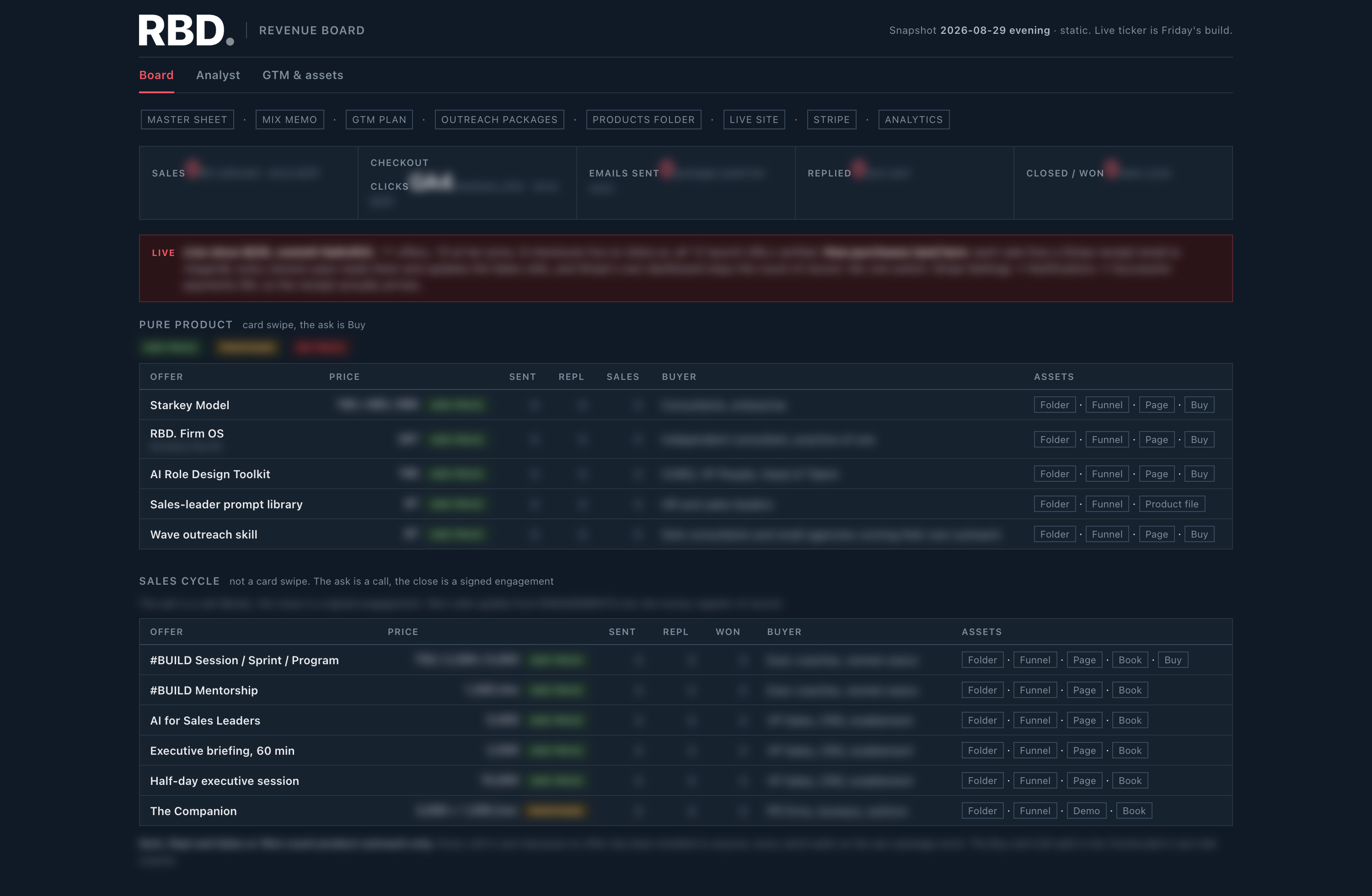
RBD.'s live revenue board
The revenue board. Every offer, price, send, and sale on one page. The template ships in the box; this is RBD.'s own, running.
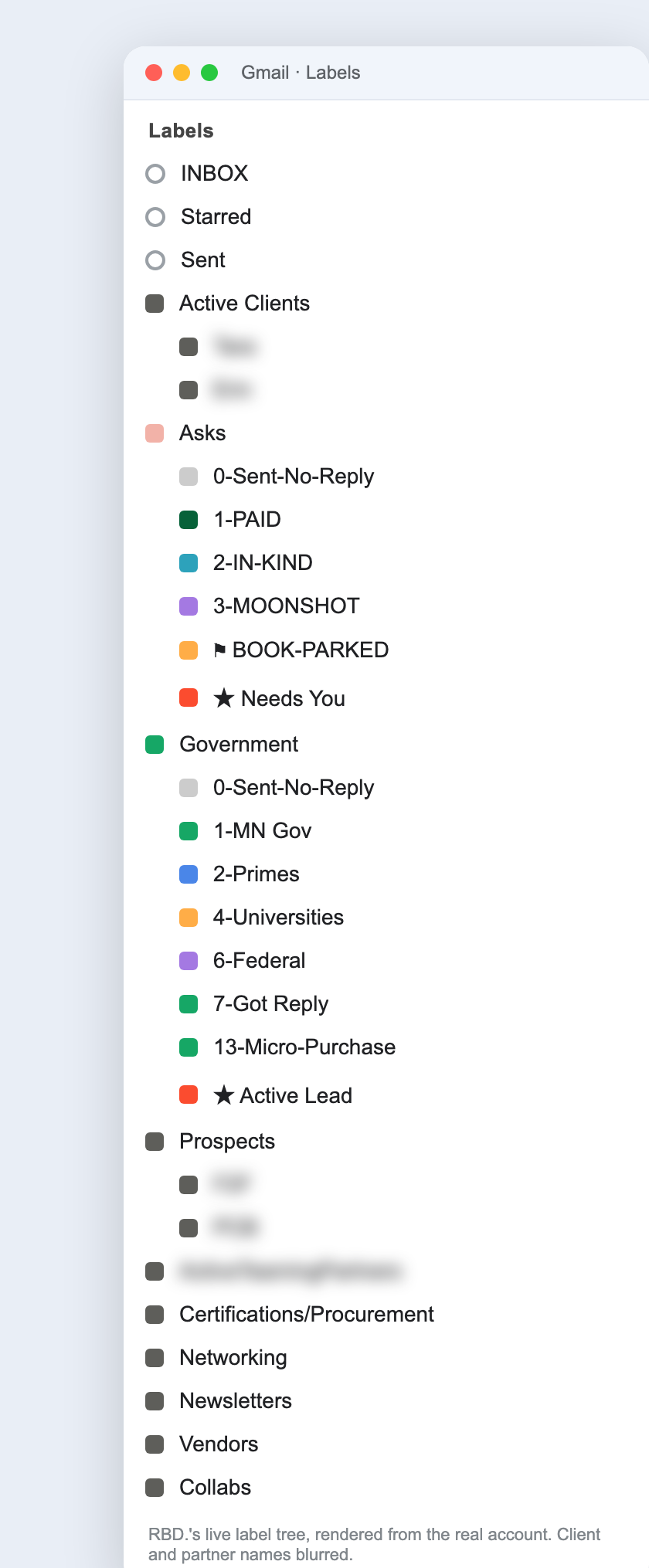
RBD.'s Gmail label tree
The labeled inbox. RBD.'s real Gmail tree: every ask, reply, and government thread filed by the system, not by hand.
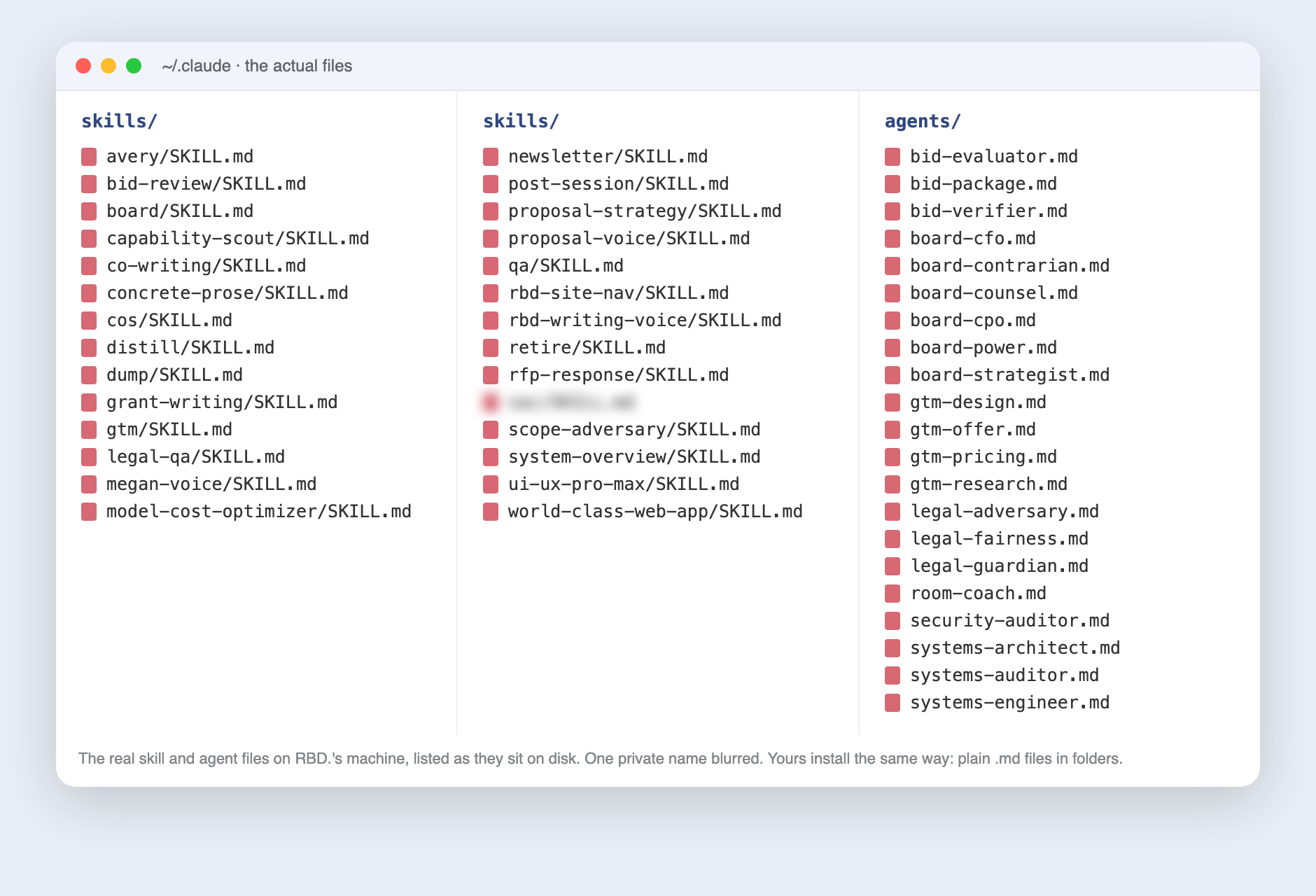
The actual skill and agent files
The files themselves. The skills and advisor seats as they sit on disk, plain .md files in folders. Yours install the same way.

Open each piece below. Nothing here is a black box.

Each seat is an agent, a one-page job description for an advisor. Every sample below shows the real shape of the file. The full manifest, itemized piece by piece →

01 · Advisory
The Advisory Board
Six advisor seats argue a decision before the money is spent, and the disagreement sits on the page where you can read it.
board-session-transcript.mdSample
board-strategistdirection: build vs. drop
Recommends holding the workshop line and cutting the enterprise track until Q2 demand is confirmed.
board-cforunway, pricing, cost vs. return
Flags the proposed discount as a margin risk against the current burn rate.
board-contrarianargues against the plan
Disagrees with both seats above; names the untested assumption neither one addressed.
02 · Advisory
The Go-to-Market Team
Four seats pressure-test an offer or a price before it goes live.
gtm-roster.mdSample
RESEARCH
buyer, demand
Segment shows highest reply rate among referred leads.
OFFER
hook, ask
Recommends leading with the diagnostic, not the retainer.
DESIGN
page, conversion
Flags the pricing section as buried below the fold.
PRICING
tiers, margin
Sets the middle tier as the anchor, not the lowest.
03 · Operations
The Chief of Staff
A new ask gets filtered against your real priorities instead of taking over the day.
PRIORITIES.mdSample
Top 3 · 1Close the Q3 retainer renewal
Top 3 · 2Finish the workshop deck
Top 3 · 3Reply to the referral intro
ParkedRebuild the onboarding page
AutopilotWeekly invoice reminder
04 · Operations
The Systems Team
Nothing you build gets called finished until something else checks it.
build-request-042.mdSample
Build-With-Changes
The proposed automation touches the same file two other routines write to; add a lock before this ships, otherwise approved as scoped.
05 · Foundation
The Memory Architecture
A correction, filed once, loads at the start of every later session.
feedback_client_rate_range.mdSample
type: correction · filed: 2026-03-11
Quote a range, never a single number, until the scope is signed. Repeated twice before this was written down.
06 · Foundation
The Knowledge Graphs
A reference document stays accurate for the whole session instead of getting paraphrased wrong.
prospect-graph.mdSample
Things
Northfield Fabricators, Cascade Legal Partners, Amsler & Voight
Connections
Northfield Fabricators → referred by → Cascade Legal Partners, warm, Feb intro
07 · Foundation
The Routing Layer
The right files load themselves at the start of every session.
MANIFEST.mdSample
New clientintake.md, rate-card.md, scope-template.md
Weekly reviewpriorities.md, campaigns-board.md
New offerpricing-list.md, gtm-notes.md
08 · Foundation
The Working Skills
28 skills, from proposal strategy, proposal voice, and RFP response to the clarity pass and the daily dump. Each runs by name, each with its own instruction document.
skills/Sample
Intake
Routes a status update
Retire
Closes a session
Clarity
Tightens a sentence
Router
Picks the cheap model
Docs
Keeps itself current
09 · Templates
The Campaigns Board Template
One row per offer in the market, so you always know which one is working and which one to retire.
CAMPAIGNS-BOARD.mdSample
Offer
Diagnostic Sprint
Status
Active
Sent
7
Reply
2
10 · Curriculum
The Teaching Guides
Each piece arrives with the same lesson a paying client already received.
guides/05-the-auditor-seat.pdfSample
05 · The Auditor Seat
Guide, delivered curriculum
What the auditor checks, how it differs from the engineer that built the thing, and when to call it in before you trust a report.
11 · Delivery
The Install
You answer three questions. Everything then arrives plug and play, as folders you copy in, with an instruction document beside every piece and a prompt pack to fit each one to your firm.
Order confirmationSample
1. Your firm, in one line
Independent tax and compliance advisor
2. Tools you run on today
Email, calendar, one document folder
3. Your most common client type
Small-business owners, annual filings
Delivery: 1 business day
/firm-os
  /advisory-board
  /memory
  /guides

Every skill, by name.

Each line states what you gain. Hover or tap any skill for the design logic inside it. Each skill arrives with its own instruction document plus a prompt pack for fitting it to your firm. The environment write-up walks every one in full.

cos

You open each day knowing the top three things that deserve you, and what to ignore.

The logic inside

Every decision reaches you framed, with options and a recommendation. The seat filters and drives; it never decides, and it never chases you.

assistant-charter

Your calendar, drafts, and follow-ups are handled, and nothing sends without you.

The logic inside

A written charter separates what you owe others (the assistant) from what you are deciding (the chief of staff). Every outbound stops at a draft.

dump

You say what happened once, in your own words, and every piece lands where it belongs.

The logic inside

A routing table names which file owns which kind of fact, so nothing is logged twice or filed nowhere. A fresh dump outranks any older record.

retire

Sessions end clean, and the next one starts already briefed.

The logic inside

A closing ritual moves only what earned keeping into permanent memory. Short sessions restarted clean compound; one long session drifts.

capability-scout

You find out what the system can do that you are not using yet.

The logic inside

It reads your actual usage against the installed inventory and names the gap, so the machine you paid for does not sit idle.

your-voice

A note to a specific person sounds like you wrote it, because the register maps to the recipient.

The logic inside

Voice is mapped per relationship, not one house tone. The last ten percent of every draft is edited by you, and that stays the rule.

co-writing

Long documents get written with you, never silently rewritten for you.

The logic inside

Your own sentences are never changed without a veto. Every proposed edit is listed beside the original, and the structure comes from your motion, not a template.

concrete-prose

Dense drafts become sentences a reader can act on without translating them first.

The logic inside

The test is who does what. It hunts abstractions sitting where a person or a named thing belongs, because that is why readers bounce, not length.

house-voice

Everything you publish reads like one firm wrote it.

The logic inside

Register and banned-word rules are enforced by a small program at save time, not by anyone remembering them.

newsletter

Finished research becomes an email your reader opens and finishes.

The logic inside

One finding is re-cut for the reader receiving it, and every figure stays traceable to its source file, so nothing goes out you cannot defend live.

post-session

A client working session becomes a finished, sendable package the same day.

The logic inside

Each deliverable copies the format of the last document that client accepted, so what ships matches what already worked.

site-style

Every new page lands consistent, indexed, and quotable.

The logic inside

One navigation standard plus structured data on every public page, so answer engines can retrieve and cite it. A working lead source, proven once already.

gtm

An offer is pressure-tested by four seats before it goes on sale.

The logic inside

The seats are read-only and every price is a recommendation until the owner agrees. The pricing seat argues against the funnel seat on purpose.

proposal-strategy

Your bid argues what moves the buyer's score, not what fills pages.

The logic inside

Strategy is set before prose. Effort concentrates on the factors the buyer weights, in the order the panel reads.

proposal-voice

Your proposals read like the ones buyers already chose.

The logic inside

The register is derived from 558 pages of public McKinsey and Gartner proposals. Median sentence 21 words, zero contractions in the whole corpus.

rfp-response

Your response lands in the buyer's own structure, where evaluators can score it.

The logic inside

Submission documents keep the buyer's section names in the buyer's order, because panels score with a checklist and findability beats cleverness.

grant-writing

Grant applications speak to funders in a funder's terms.

The logic inside

A separate lane from contracting, because a funder reads for mission fit where a contracting officer reads for compliance.

scope-adversary

You sign knowing what the scope will actually cost you.

The logic inside

It reads your agreement the way the client will read it in month three, and prices every unpriced ask before your signature makes it free.

key-account

Your most important relationship gets a staffed team of its own.

The logic inside

A context keeper stays separate from the writer, so advice comes from current facts on file, not from a memory of them.

qa

Nothing ships with a claim that fails a live challenge.

The logic inside

A fast mechanical check runs on every save and a slow judgment pass runs on request. Both, never just one.

bid-review

Your draft is scored before the buyer ever scores it.

The logic inside

Defect passes run on every bid because they never stop finding. Scoring panels run only where the buyer published weights, because scoring saturates.

legal-qa

Your agreement is attacked before the other side gets the chance.

The logic inside

One seat checks your standing protection list, one simulates opposing counsel, and one rewrites your asks as rules that benefit every party, so they survive review.

distill

A pile of one-off observations becomes a standing rule.

The logic inside

The pattern is written into the exact place it would fire next, so a lesson costs its price once.

board

A decision gets argued before the money is spent.

The logic inside

A standing contrarian seat is built to disagree on purpose, and the disagreement lands on the page where you read it, not after the spend.

model-cost-optimizer

Routine work stops running on premium rates.

The logic inside

Each task routes to the cheapest model that passes the task's own check. Escalation requires a measured failure, never a hunch.

system-overview

Anyone can see your whole machine on one page.

The logic inside

The map regenerates from the files themselves, so it cannot drift from what is actually installed.

ui-ux-pro-max

Anything with an interface ships at a professional standard.

The logic inside

Design is decided against a written standard, so quality does not depend on taste on the day.

world-class-web-app

Web work ships production-grade, and done means verified.

The logic inside

Build standards carry their own verification steps, so a finished claim is a checked claim.

Stop re-explaining your business every time you open a prompt.

The box installs a custom Firm Memory System, a dedicated, automated second brain that makes your AI immediately intelligent, fully context-aware, and aligned with your operations.

The problem

  • Starting from scratch. Every chat session begins at zero, and high-value time goes to briefing the tool on basic context.
  • Repetitive mistakes. AI models forget past corrections, so you fix the exact same errors over and over.
  • Inconsistent results. Unstructured rules produce unpredictable output that compromises quality.

The solution and the value

  • Instant context. Your AI reads your firm's facts, rules, and history before you type a single character.
  • Permanent learning. Correct the system once, and it obeys that rule across all future sessions automatically.
  • Hard guardrails. Enforcement scripts handle compliance, formatting, and the non-negotiables, so you do not rely on model memory alone.

Ready to plug this architecture into your current workflow?

Built by the person who runs the firm it was built for.

Megan Starkey is CEO and Principal Consultant of RBD. and the author of The Intelligence Organization. She built this to run her own practice first.

CEO & Principal Consultant, RBD. Author, The Intelligence Organization Runs a real one-person practice

The fixer never certifies the fix. Week one proved why.

In week one, the engineer seat wrote a confident diagnosis with five claims in it. The auditor seat checked each one against the actual files. All five were made up.

The inspector caught the mechanic inventing a repair on day one.

> systems-engineer: pipeline diagnosis complete
> systems-auditor: verifying 5 claims against live state...
  ✗ claim 1: log path does not exist
  ✗ claim 2: referenced entry never written
  ✗ claim 3: tool never actually run
  ✗ claim 4: fabricated
  ✗ claim 5: fabricated
> underlying state, checked directly: mostly healthy

Reconstructed to show the shape of the check the auditor ran, not a literal log excerpt.

This was a working machine before it was a product.

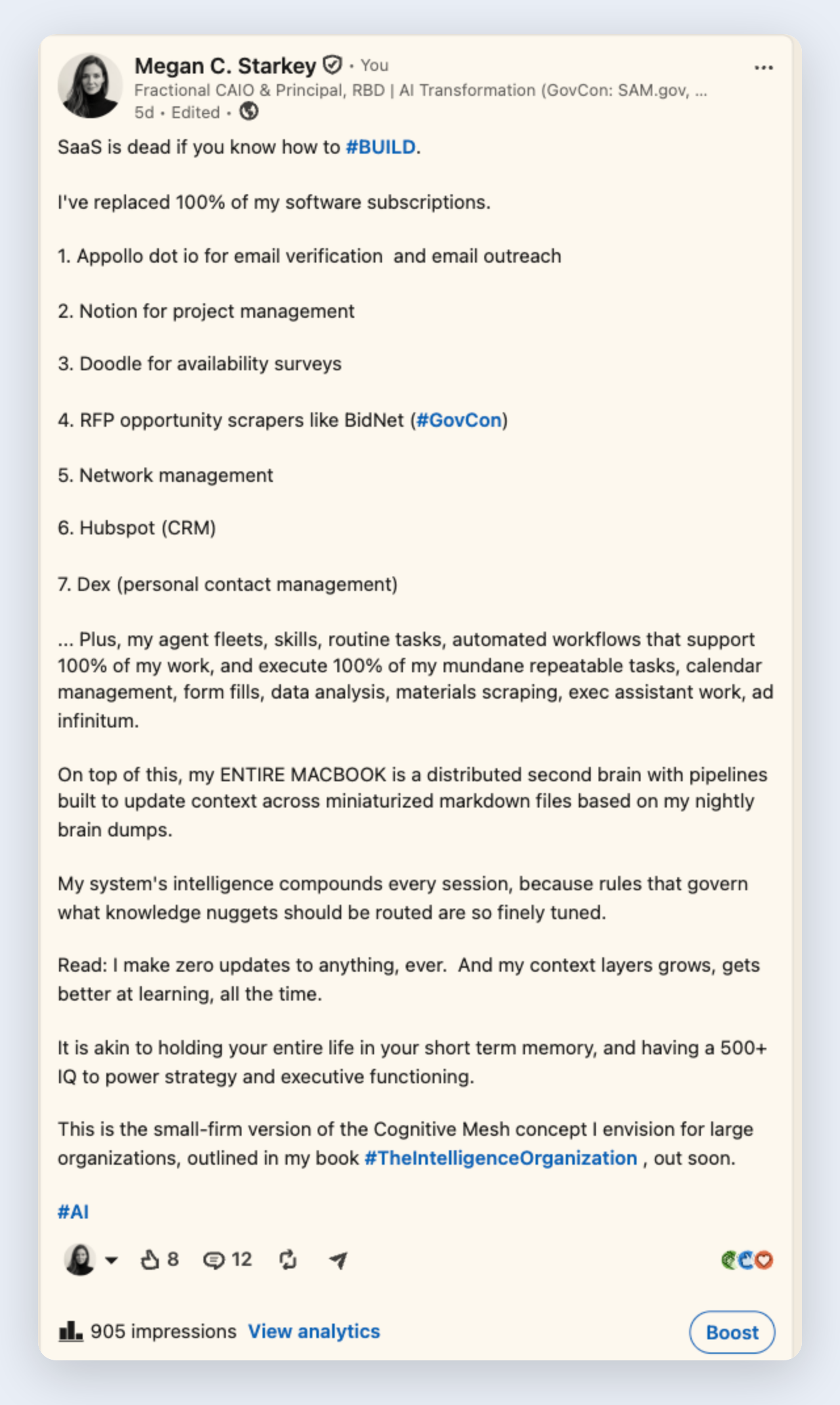
Megan posted what her setup had replaced, and the builders in the room asked how. The answer is documented in full, in the open, before you pay for anything.

Megan Starkey's LinkedIn post on replacing her software subscriptions

Bought one at a time, the pieces cost $1,743.

Every anchor is a price RBD. actually charges elsewhere. Not a manufactured bonus stack.

ComponentThe benefitHonest anchor
Chief of staff
(intake and routing)
New information files itself. A $99/mo tracking tool still leaves you sorting. This sorts.
Advisory board
(standing contrarian seat)
A standing second opinion, before you commit. The live version sells at $1,500/mo. This ships the pattern.
Go-to-market team
(offer, pricing, research, design)
Four seats pressure-test every price and pitch. One hour of this sells at $2,500. This ships the seats.
Systems team
(architect, auditor, contrarian)
Nothing is done until something checks it. The live version is the $750 Build Session. This ships three roles.
Working skills
(28, proposal strategy to the daily dump)
Repeated judgment calls run the same way every time. Priced like RBD.'s own $129 templates, five of the 28 alone are $645.
Memory & routing architecture
(knowledge graphs, starter doctrine)
What you learned the hard way governs next time. Taught as a course, $249. This ships the finished structure.
Teaching guides
(from curriculum delivered to paying clients)
The walkthroughs paying clients received. Already delivered inside paying engagements.

Build Session $750 + just five of the 28 skills at $129 each + the $249 architecture + one month of a $99 tool = $1,743. All of it, assembled: $297, once.

This is for a firm of one.

A fit if
  • You run a firm of one and want the structure that runs RBD., whether or not you have opened Claude Code before.
  • You want a second opinion before things go out the door.
  • You would rather install it than spend four months building it.
  • You can copy files into a folder and read a guide.
Not a fit if
  • You want a hosted app with a login. This is files you own, running in Claude Code on your machine.
  • You want it to run unattended. It works only while Claude Code is open.
  • You want it fitted to your practice live. That is the Build Session, $750.
  • You need this for a team. It installs for one person.

$297. Once.

$297
24 advisor seats · 28 working skills · 6 rule hooks · 10 client-taught guides · the memory and routing architecture · a prompt pack to fit it to your firm · delivered in one business day
Get the System · $297

Early buyers keep this price as the system grows.

Purchases are governed by the Terms of Sale and Refund Policy.

What shapes your build: three questions
  1. What kind of firm are you, in one line?
  2. What tools run your work today: email, calendar, documents, anything else by name?
  3. What client type or engagement do you serve most?

Why there is no refund

Digital delivery; all sales are final, per the Terms of Sale and Refund Policy. In place of a guarantee, everything in the box is described on this page and, in more depth, in the complimentary manual you can read before you pay. Early buyers keep this price as the system grows.

Want it fitted to your practice in a live working session instead? That is the Build Session, $750.

Every real objection gets a plain answer, no dodge.

Eight questions, each closing one real objection.

Does this run on its own, or is it a managed service?
Neither. It runs on your own machine, only while Claude Code is open, and nothing sends or changes anything without you. RBD. operates none of it.
What do I need to run it?
Claude Code, Anthropic's system environment, on a Mac or Linux machine; the install guide walks you into it if you have never opened it. The subscription is a separate cost paid to Anthropic, starting around $20 a month, so the $297 is not the whole cost of running the system.
Am I technical enough to install this?
Install is copying files into a folder and reading one guide.
Is any of my data involved?
No. Everything runs on your own machine, inside your own Claude Code session. RBD. never sees your files, your memory, or your client data.
What if something is missing after I get it?
Email megan@rbdco.ai and it gets fixed the same business day.
Why is there no refund?
Digital delivery; all sales are final, per the Terms of Sale. Everything in the box is described here and in the complimentary manual before you pay.

The staff a one-person firm does not have, waiting in your inbox by tomorrow.

Everything above is already described in full, and again in the complimentary manual. $297 gets you the assembled version, installed for your firm.

Get the System · $297